


Postural dysfunction shows up as your body aligns poorly while sit, stand, or make other bodily movements. Lack of alignment can lead to muscle imbalance(s), pains, and a few chronic and long-term conditions. How people get them usually boils down to lifestyle factors; sitting for long, poor postures, weakened core are some causes. In this milieu, what is Hourglass syndrome? It is a wise thing to know the causes, signs and fixes.
Common types of postural dysfunction are kyphosis (rounded upper-back), lordosis (excessive inward curve of your lower-back), scoliosis (sideways curvature of your spinal column), sway-back (your pelvic floor tilts forward and upper-body leans back), and forward cervical posture.
These conditions may not only affect your appearance but may also cause back-pain, neck strain, frequent spells of migraines, and fatigue. It helps to know trying too-hard to achieve "perfect-waistline" may in fact harm your posture and health. Postural dysfunction develops gradually due to your daily habits and lifestyle.
You need to stay wary of prolonged sitting, especially in a poorly ergonomic ambience, use of mobile phones or laptops in a slouched position, carrying heavy bags on one side, or sleeping on an unsupportive mattress. Jobs needing repetitive movements or awkward postures – say, desk jobs or manual labor – may also increase risks of postural dysfunction.
Moreover, leading a sedentary lifestyle, inadequate core muscles and strength, and imbalance due to prior injuries can contribute to your faulty posture(s). At times, psychological stress may alter your posture. Early awareness and corrective measures, - including workouts and ergonomic corrections - are key to prevent and manage postural dysfunction.
What is Hourglass Syndrome?
Hourglass Syndrome — also called stomach gripping — is a condition wherein you may habitually and unconsciously pull-in your abdominal muscles. This constant tightening – mostly done all-through the day - causes an illusion of having a slimmed-down waist or a flat tummy!
This may seem a minor issue; but this unnatural posture adds strain to your muscles. This can lead to poor alignment of your spinal and pelvic regions. Over time, it may disrupt your normal breathing-patterns, impair functioning of key organs, and may cause chronic muscular-imbalance(s). This is indeed a point-of-major-concern to not-just athletes but also for all others .
So, what causes Hourglass Syndrome?
Hourglass Syndrome may arise off an interplay of biomechanical factors, psychological stressors, and socio-cultural triggers. One of the most prominent causes is peer pressures to have a perfect body-imagery.
Many individuals - especially women - are encouraged to "suck-in their bellies" to sport a slimmer look. A flatter tummy remains a dream of many people. Your postures and core get gradually altered by such repetitive practices, and eventually turn into a subconscious habit..
A weakened core is another reason. When your deep-core muscles - like transverse-abdominals are underdeveloped - your body compensates it by overusing surface-level muscles, like upper-abdominals. When you overuse shallow-muscles, it can mess-up your body’s natural movements and make your tummy tight or clenched-in. Emotional stress or anxieties can further worsen this. While under stress, you may unconsciously tighten your abdominal muscles to respond to stress.
Over time, such a tension gets ingrained into your daily posture. This activates muscle group dysfunction as well as a poor alignment. The result is Hourglass Syndrome – if this absence of alignment stands uncorrected.
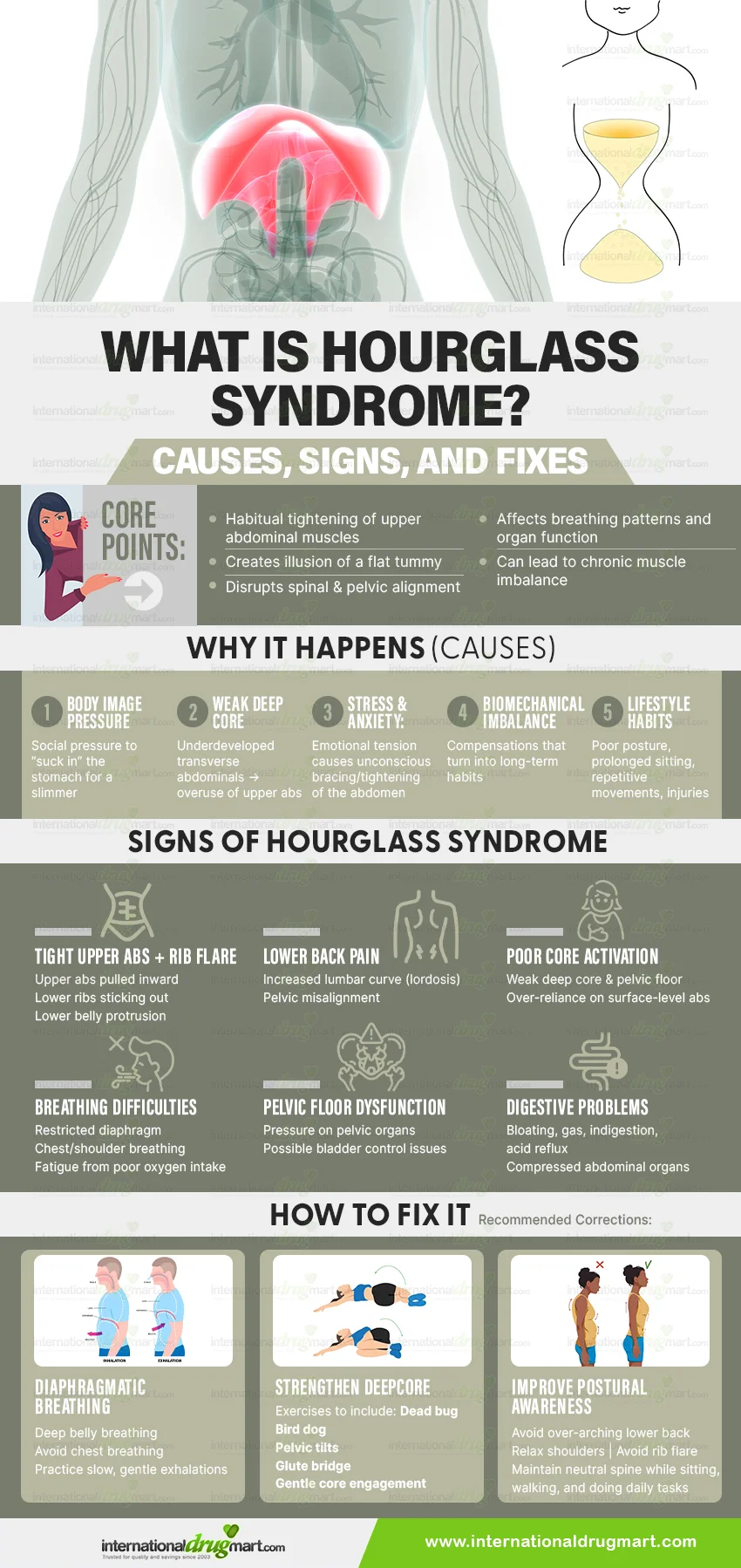
Signs Hourglass Syndrome
Hourglass Syndrome can be identified by discerning its signs. An early detection adds vigor to corrective actions. Common signs of this syndrome include:
Tightened upper-abs and rib-flaring – Your upper abdominal muscles get pulled inwards. This makes a dip in your midsection. Your lower abdomen starts to protrude and may turn weak. Rib-flaring - occurs when your lower ribs stick-out or flare-forward as upper-abdominals are stressed-out.
Lower back-pain – Abdominal gripping affects your alignment of your lower pelvic musculature and organs thereof. This may lead to lumbar lordosis (an excessive curvature of your lower-back) causing chronic pain or discomforts there.
Poor core activation – Your upper-abdominals overcompensate deeper core muscles while your transverse-abdominals and pelvic-floor may remain underused. This imbalance affects your postural stability and movements.
Breathing-difficulties – Tight abdominal muscles restrict your diaphragm. This makes breathing a difficult task for you to do. This may also force your body to rely on chest or shoulder to breathe. It can make your fatigued and anxious as oxygen intake becomes declined slowly.
Dysfunction of pelvic floor and organs – A constant tension at the abdominal region adds on to pressures on muscles of your pelvis. You tend to see lack of bladder control, painful pelvic organs and strain on the deep pelvic muscles.
Digestive problems – Sucking-in your tummy constantly compresses internal organs; this causes flatulence, bloating, formation of gas, acid reflux, indigestion, as well as erratic bowel movements.
How to Fix Hourglass Syndrome Naturally
You can fix Hourglass Syndrome with the support of caregivers. They you’re your body retain its right posture, breathing, and movement(s). The below-mentioned are most-commonly used:
Breathing exercises – You are advised to pursue deep breathing involving your diaphragm i.e., no more chest-breathing! Practice gentle exhaling and repeat it for a few minutes every day.
Strengthen your inner-core – Focus on strength-building of your transverse-abdominals and pelvic-floor. Workouts: dead bugs, bird dogs, pelvic tilts, bridge pose, and core engagement can help. These workouts engage your deep core-muscles from the inside-out, without adding much strain onto your other muscles.
Building postural awareness and correction - It helps to keep a check on your posture throughout your daily activities. It pays to critically-look at how you walk, sit and do chores. It helps to keep your shoulders relaxed and refrain-from arching your lower back or flaring your ribs up.
Above all, you are advised to consult with a medical professional. If signs of Hourglass Syndrome persist for long, consult with a physical therapist, chiropractor, or a corrective-exercise specialist. These professionals can analyse your postural alignment(s) and respiratory function. Using these insights, a rehab plan is customised to suit your medical condition.
If you are living under stressful conditions, practices such as deep breathing, yoga, meditation, or journaling may help reduce anxieties.