


Red blood cells count in your (adult) system is more than 44% of your blood volume. The share is higher i.e., more than 57% in infants. These cells carry oxygen – known as hemoglobin - all through your body. Size of these blood cells and their oxygen-beating capacity are measured by parameters like MCHC, MCV, MCH, and RDW. These four indices primarily determine the cell-level energies of your red cells. It helps in understanding MCHC, MCV, MCH and RDW in detail.
Red blood cells are also known as erythrocytes. These cells are most common in your bloodstream. They serve as a key channel through which your body gets oxygen for sustenance. These cells get oxygen from lungs. It is then released into several organs via tissues; this action is done as blood squeezes in through finer-tubes called capillaries.
Understanding MCHC, MCV, MCH, and RDW blood tests
Now we can look into the main parameters of your red cells. They include the following:
- MCV – Mean Corpuscular Volume
- MCH – Mean Corpuscular Hemoglobin
- MCHC – Mean Corpuscular Hemoglobin Concentration, and
- RDW – Red cell Distribution Width
MCHC, MCV, MCH and RDW are considered as key indices relating to the characteristics of your red cells. Through these 4 values, you get to know how rich are your red cells with hemoglobin and how big (or small) your red cells are. Caregivers gain access to key information on oxygen-concentration of your red cells. As an added use, these values help diagnose as well as classify types of anemia – i.e., if you are anemic.
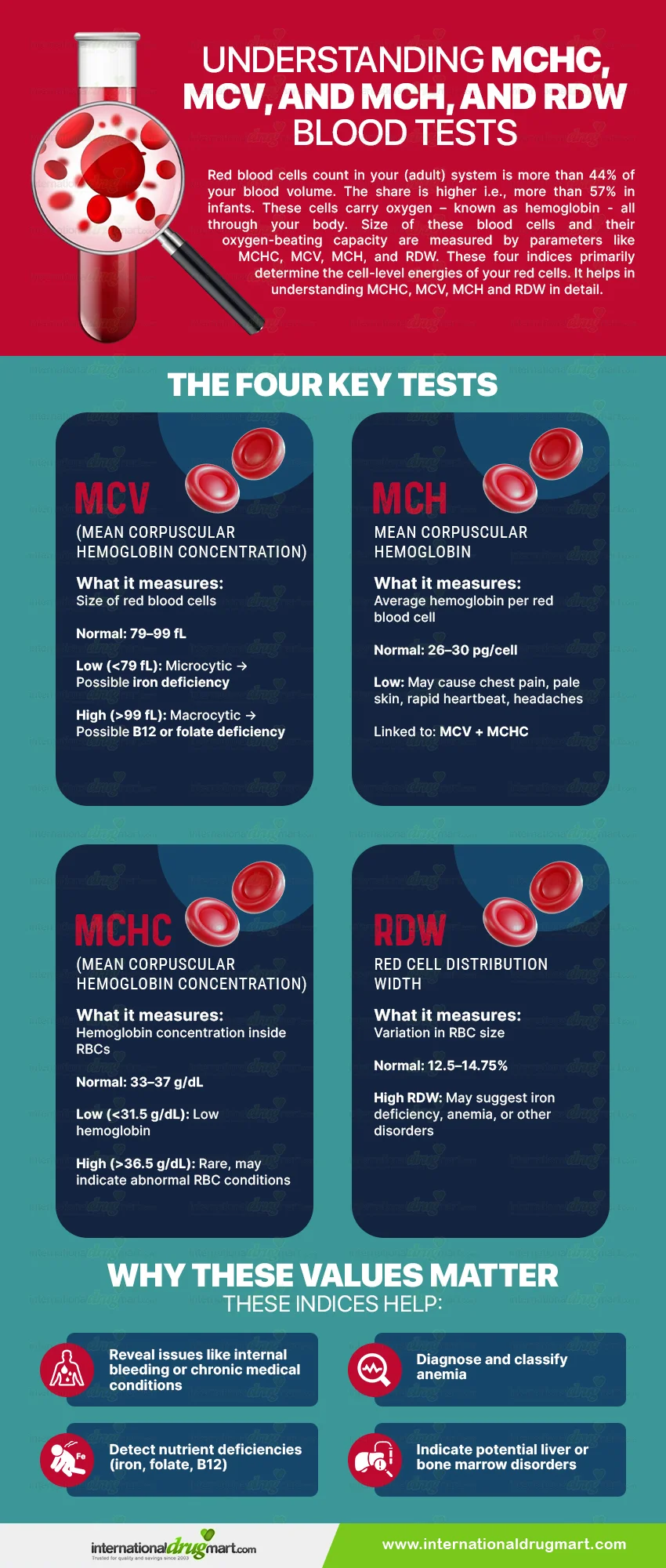
Mean Corpuscular Hemoglobin Concentration (MCHC) - This value indicates the average hemoglobin concentration in your red cells. MCHC value tells you of hemoglobin i.e., whether it is high or low.
Variations of MCHC values can reveal quite a few things about your current blood condition. Normal range of MCHC is between 33 to 37 grams per deciliter (g / dL). MCHC of less-than 31.5 g / dL is considered as a low-value. MCHC of more than 36.5 g / dL is seen as being quite high.
Mean Corpuscular Volume (MCV) - MCV measures size of red cells, on an average. Femtoliters – in short, fL is the measurement parameter for this value. A healthy value is known to hover in-between 79 – 99 femtoliters. Less than 79 fL is considered small or a microcytic condition. Values more than 99 fL are deemed as large-sized cells or a macrocytic condition.
Small-sized cells are indicative of iron-based deficiencies. On the other hand, larger MCV value means a likely deficit of folic acids / folate or B12 vitamins.
Mean Corpuscular Hemoglobin (MCH) – With this test, you can find the average hemoglobin your red cells have in them. You can represent MCH is pictograms which amounts to one trillion per gram / cell or in short - pg / cell. Values in-between 26 and 30 pg / cell are deemed as normal MCH.
Side Effects Of Anemia Among Patients With Low Hemoglobin Concentration, Low hemoglobin can make the body struggle for oxygen, leading to tiredness, shortness of breath, dizziness, pale skin, and constant weakness. Many people also notice headaches, cold hands and feet, chest discomfort, or trouble focusing. When anemia becomes severe, everyday tasks feel harder, the heart works overtime, and overall energy drops sharply, affecting both physical and emotional well-being.
Your MCH values are related to both MCHC and MCV estimates. These three indicators are at times referred as key red cell indicators / indices. You may develop symptoms like pain in your chest region, migraines, paleness, rapid beating of heart, etc. In case of levels lower than 26 pg / cell, your hemoglobin levels are at a low.
Red Cell Distribution Width (RDW) - RDW evaluates inconsistencies in size of red blood cells. When the RDW values fall in the percentage range of 12.5 to 14.75, it is a normal range. Suboptimal values are indicative of incidence of anemia or deficiencies in key nutrients.
What are these 4 RBC indices used for?
The four (4) RBC indices namely MCHC, MCV, MCH, and RDW help analyze the health of your red blood cells. The report can identify potential risks of anemia / deficiency of key minerals such as iron. There are instances of results being indicative of likely liver dysfunction; a larger-than-usual size of cells can denote possible inflammation of liver or conditions like cirrhosis.
It can be a little tricky to understand what these values truly mean: say, a high RBC, low MCV, and / or lesser MCH. Interpreting them can be challenging. However, your caregiver can help decipher these numbers for you and advise remedial measures, if needed.
These indices form part of a standard complete blood count test; this is also termed as CBC. There are however, no preparations needed for this test. A few milliliters (ml) of blood sample are collected inside a vial or a test-tube. It takes a small sting or a prick to get the needle to get in and out.
Who should take red blood cell count test?
CBC is one of the standard recommendations for individuals living with symptoms of anemia. In addition, if your doctor suspects of condition(s) affecting production of red cells, such cell count tests are ordered.
With e help of this red blood cell count test, you are able to diagnose various health ailments. Apart from anemia, these include renal disorders, bone marrow-based problems, and a few types of tumors.
- If you are living with fatigue, persistent spells of weakness, shortened breathing cycles, paling of skin, feeling dizzy often, etc., you may be advised to opt blood count test
- As part of routine checkups and general health assessments, RBC-based test panels are administered. In fact, CBC has turned a standard item in most preventive health checks.
- If you witness risks of internal bleeding – caused by ulcers or wounds within – counting blood cells can help arrive at timely diagnosis and treatment, based on your blood condition. tests can be used.
- If you have a recent history of a cardiac arrest or heart problem along with sleep apnea, it is likely to hike your RBC count. count test can alert you of possible heart risks
Your healthcare providers use MCH, MCV, MCHC and RDW blood tests for evaluating red cell indices. These indices are tell-tale signs of abnormalities deep within your blood cells. The changes in cellular volumes, size, and hemoglobin content shed needful light on your circulation system.