


Antidepressants calm your nerves and brain. These meds are taken for managing anxieties, nervousness, and mood shifts including depression. If left untreated, spells of anxieties can impair your interest in most activities. You may also develop hardships focusing on tasks on hand. Depression can arise due to many conditions; a few being persistent depressive disorders, seasonal spells of depression, etc. Drugs such as Wellbutrin are administered. It helps to know what happens while increasing Wellbutrin dosage from 150 to 300.
Antidepressant-meds alter the availability of brain-transmitters, and thus streamline your moods. Many meds of this family work on chemicals such as norepinephrine, serotonin, etc. A few selective meds work on presence of chemicals like dopamine. Meds falling under antidepressants take time to yield desired results. The typical span of use ranges from 5 to 9 weeks. You may need to keep taking them for the signs of depression to ease.
Your mental health provider may decide upon what med works best for you. Caregivers look into a host of factors like nature of symptoms, probable risks – in the form of adverse effects, your current health condition, etc.
In this milieu, what is Wellbutrin?
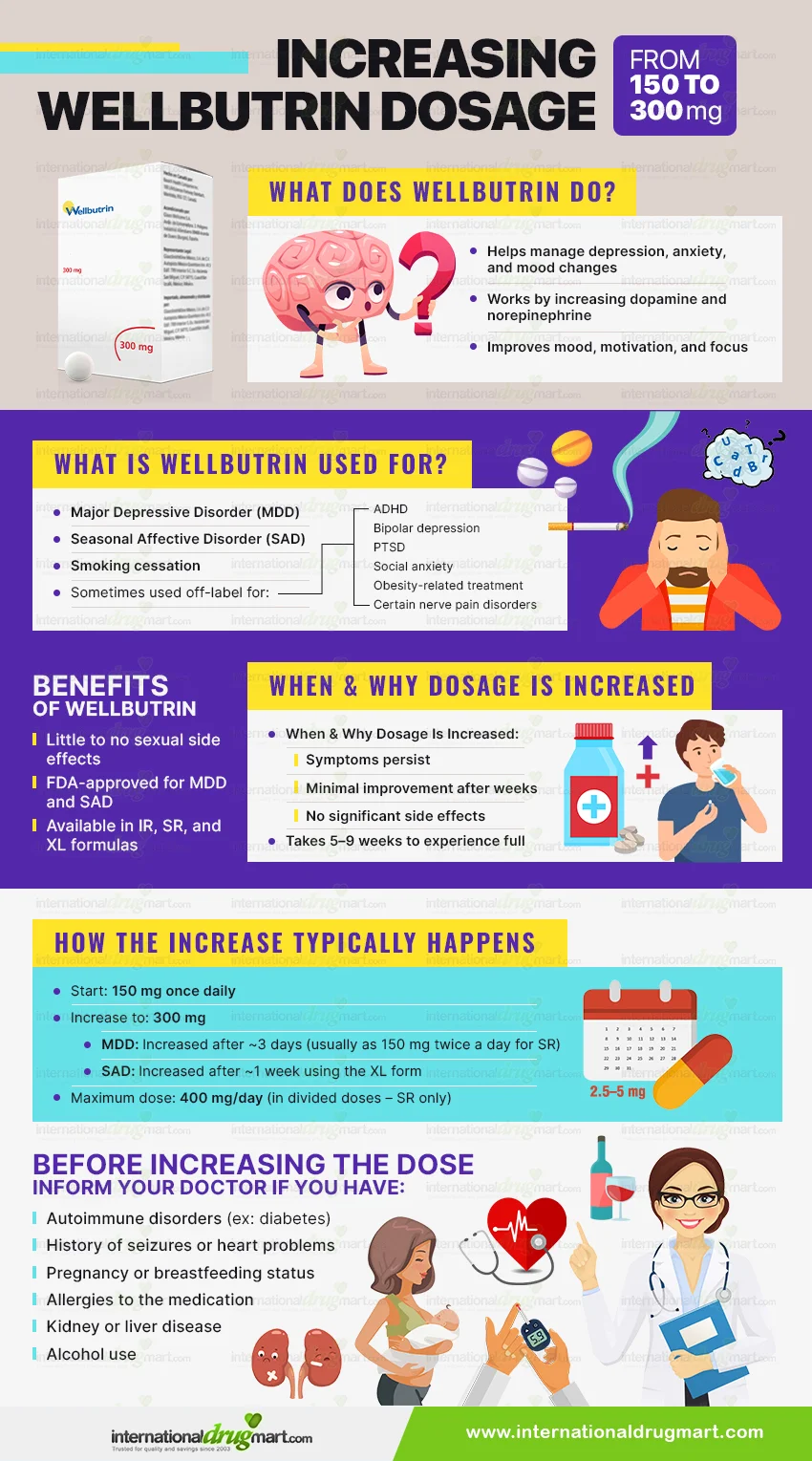
Seasonal depression is a medical condition that responds well to Wellbutrin. This med is also administered to help you quit habits like smoking. Wellbutrin is known for increasing dopamine and norepinephrine in your cerebral system. You can buy it as a sustained release, delayed release or as an immediate release variant.
The good thing about Wellbutrin is it has little / no impact on your sexual function. Users do not complain of any drop in their libido. This med has the approval of the US-based drug clearing body Food and Drug Administration (FDA). It bears clearance for seasonal affective disorder (SAD) as well as major depressive disorder (MDD).
Apart from above two conditions, Wellbutrin is also administered – off-label – for anxieties, bipolar disorders, attention deficit hyperactivity disorder, post-traumatic stress disorders – to name some. Some caregivers have used it for social anxiety disorders, being overweight and a few types of neuralgia i.e., nerve pains.
Wellbutrin dosage considerations
For anxiety and depression, dosage varies depending on diagnosis. Initially, a low dose is given to avoid adverse reactions. After two months, if your caregiver finds no improvement, he / she may gradually increase the strength.
Wellbutrin dosage strengths are 100 mg, 150 mg, and 200 mg for sustained release. As an extended-release dosage, you can avail either 150 mg or 300 mg dose.
If you have kidney or liver-related ailments, your caregiver will prescribe a lower dose of Wellbutrin. This is mostly the case with older adults who live with a compromised renal function. Based on your renal or hepatic wellbeing, doses are modified. In case of liver disorders, 100 mg or 150 mg is offered alternate days.
Increasing Wellbutrin dosage from 150 to 300
Patients (adults) suffering from Major Depressive Disorder (MDD) can initially take 150 mg Wellbutrin SR once daily. Doses are increased to 300 mg after three (3) days, which you can divide into two doses of 150 mg each. Between each dose you need at least 8 hours interval. The doses are split at 200 mg as two doses, which amounts to a maximum of 400 mg daily.
Seasonal Affective Disorder (SAD) – Wellbutrin XL is FDA-approved to treat this condition. For adult patients, you can begin with a 150 mg dose once daily. It is increased to 300 mg after a week’s time. However, trials are not conducted of 300 mg dosage.
How long does it take for Wellbutrin XL / SR to start working:- Wellbutrin XL / SR does not work overnight. Many people start noticing small changes in energy, mood, and focus within 1 to 2 weeks, but the full antidepressant effect often builds slowly. For some, clearer improvements show around 4 to 6 weeks of regular use. Your brain needs time to adjust to the medication. Staying consistent with daily doses, tracking mood changes, and following your doctor’s guidance can help you understand how well it’s working for you.
Before increasing Wellbutrin dosage from 150 to 300, you need to inform your caregiver / pharmacist of allergies to this med, if any.
You also need to disclose of disorders pertaining to your kidneys and / or liver. Those who are habituated to drinking alcohol, living with autoimmune conditions like diabetes mellitus and recent cardiac arrests must share details about such conditions.
Increasing Wellbutrin dosage from 150 to 300 may make you dizzy. This can increase the odds of accidental falls. You hence need to avoid driving, handling heavy machines, and refrain from tasks needing alertness. It is unsafe to take alcoholic beverages as risks of seizures run high.
Pregnant women or someone who is planning to become pregnant need to consult their caregiver before talking Wellbutrin. In addition, women nursing an infant should also follow proper advice of their caregiver regarding Wellbutrin usage. Caregivers carefully prescribe this med only if the benefits clearly outweigh risks.
Wellbutrin drug interactions
Like most antidepressants, Wellbutrin interacts with other meds. It is known to work adversely with drugs like pimozide, codeine, thioridazine, and tamoxifen. Therefore, it is a good idea to avoid using them in combination.
In addition, Wellbutrin does not go well with MAO inhibitors (in short, MAOI). It is a safe thing to avoid taking MAOIs for at least two weeks before and after taking Wellbutrin. In this light, it is helpful to know of widely used MAOIS such as isocarboxazid, tranylcypromine, phenelzine, etc.
Of these MAOIs, isocarboxazid is taken for phobias, panic as well as anxieties. Phenelzine is another medication for atypical depression. But, this is not a right drug for bipolar / manic spells of depression. Lastly, another med to treat major depressive disorders is tranylcypromine. This drug is prescribed only when other meds have failed to improve your mental condition.
Beware of excessive intake of Wellbutrin as it can lead to toxicity or over-availability of brain substances like norepinephrine. You are advised to report of adverse effects like rapid heartbeats, pain in chest region, nausea and vomiting spells.
Caveat: discontinuing the use of Wellbutrin – all of a sudden – or without your caregiver’s consent can be unsafe. Doing so can lead to withdrawal symptoms like nausea, headaches, and irregular vitals. You are advised to take Wellbutrin exactly as in the prescription. If the drug shows no signs of improvement, you can consult your caregiver for any other suitable option.
You can call your doctor or report side effects to FDA at 1-800-FDA-1088.